New Curve, New Era
Nothing has fixed tokenomics because every attempt leaves the underlying curve untouched. It's time to change the curve itself.

For anyone in crypto who has ever traded a token, there always comes a point where you ask: "why does everything I buy always go to zero?"
Governance tokens. Utility tokens. Memecoins. DeFi. Gaming. Fractionalized NFTs. Staking. Restaking. Flywheels. Taxes. Buybacks. It doesn't matter.
It's easy to write off everyone in crypto as greedy, scammy, and extractive, but there are also plenty of well intentioned founders who've launched tokens and failed too. Enough, at least, to investigate if there is a deeper reason why launching a successful token is harder than it seems.
The Tragedy of Heaven DEX
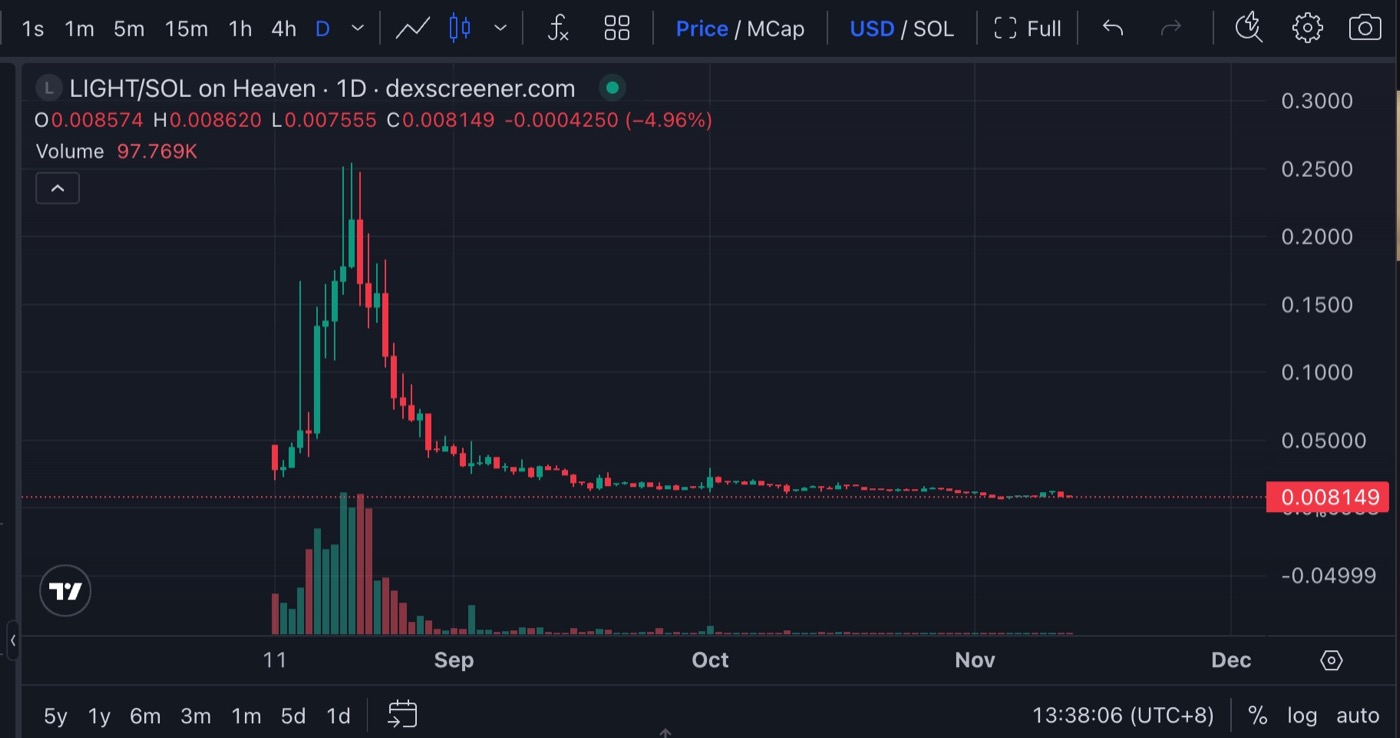
There are countless stories, but one of the more memorable examples from this past cycle was Heaven/$LIGHT. They stood out to me because it was clear from their communications that they were thoughtful, well-intentioned, long-term players looking to change the game. They didn't seem like the kind of team to cash out from a 'flash in the pan' moment, yet there's nothing that distinguishes its chart from a bonafide scam.
Their post-mortem had some interesting clues:
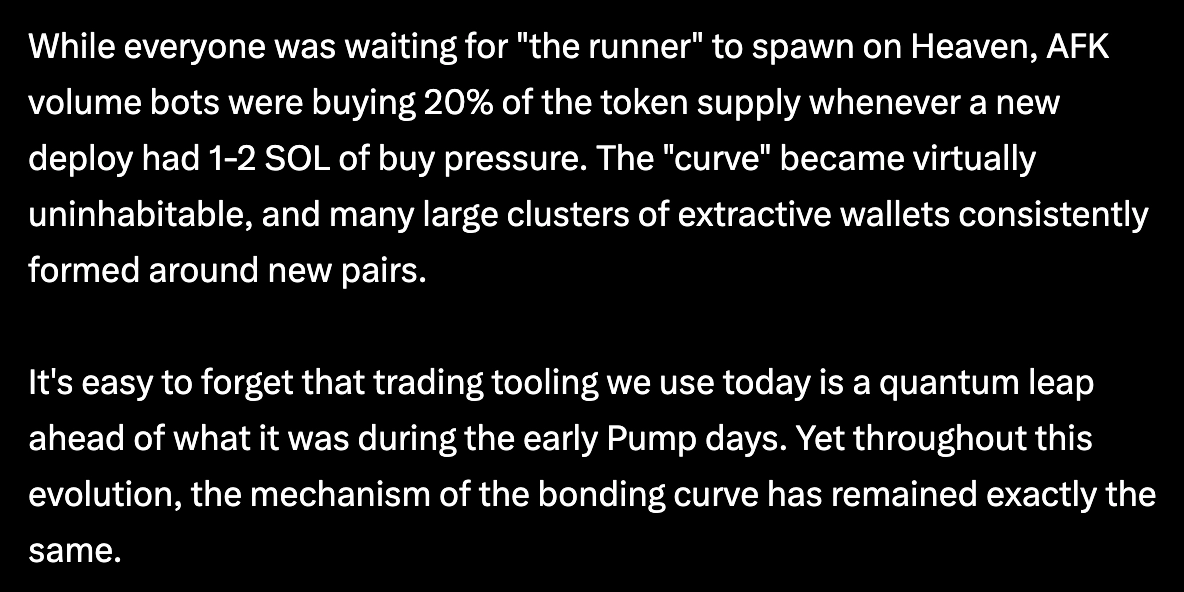
In it, they correctly identified the causes that led to their ultimate demise: improved trading tooling, sharper adversarial flow, and the curve quickly becoming "uninhabitable."
But this framing misses the most important detail. In the post, they blame the lack of innovation around the bonding curve and the evolution of bot tooling, pointing to external factors around the liquidity pool. It's a classic case of addressing the symptoms while ignoring the root cause.
In reality, the issue isn't the bots, the tooling, or the launch conditions. While they certainly don't help, no one showed up just to ruin Heaven's party. They are just the consequence of an easily exploitable system. The curve didn't decide to suddenly become uninhabitable; in fact, it was behaving exactly as intended.
The More Things Change, the More they Stay the Same
Throughout the years, despite the many launchpads conceived to "fix tokens", nothing has stuck as a permanent solution. This is because they all focus on modifying the extrinsic conditions and incentives around the liquidity pool while leaving the underlying economics of the swap untouched: the constant product curve, x*y=k.
Traditional market makers are designed to harvest fees from volatility. Their entire model is built around having a balanced inventory so they can always buy when traders sell, and sell when traders buy, extracting a spread in both directions. They don't care about long-term value accrual or price appreciation of the token, only about their PnL.
Constant-product liquidity is a naive attempt to approximate this behavior: it assumes the pool should remain balanced and treats all flow as symmetrical volatility because that's what a neutrality-oriented, extractive system would do. This works fine for pools sitting between two external assets—something like ETH/BTC—where the LP is indifferent to the underlying inventory, and the pool is not responsible for being the primary venue for price discovery.
But that logic doesn't translate cleanly when the liquidity is deployed by a project for its own token. In that context, the pool isn't a neutral participant: the liquidity exists to advance the long-term economic interests of everyone involved. It's there to support capital formation around the project, align incentives between participants, and help sustain the wealth effect that holders are collectively building toward.
If the objectives are different, the behavior should be too. Until these fundamental assumptions about the liquidity curve are changed, nothing will change. This is why Baseline is different: it's not about "more features" or "fancier math".
It's about changing the meaning of what it means to be an AMM. Baseline produces different outcomes because Baseline is optimizing for different outcomes.
It's not a Feature, It's a Bug
Let me illustrate a simple token launch scenario to demonstrate how x*y=k falls short. Say you are launching a token with 1M total supply. You sell 50% of the supply in a presale or bonding curve, raising 50K USDC from your community, and pairing it with 100K tokens from the treasury into a liquidity pool. Then you lock the LP to reassure the community that the liquidity is permanent. Sounds good, right?
On the contrary: you have effectively just lit 10% of the funds ($5,000) on fire.
How do we know? We can simulate how many reserves would be left if the entire supply was dumped into the liquidity pool:
k = x (100,000 tokens) * y (50,000 usdc)
x'= 1,000,000 tokens (the entire supply)
y' = k  / x' = 5,000 usdc
This leftover capital is completely untouched by the market throughout the entire lifecycle of the pool. It simply sits there, compounding with each trade, but remains permanently inaccessible to anyone actually trading the token. The more it grows, the more inefficient it becomes.
At the extreme, these losses can extend to absurd amounts. Remember $SLERF? When the dev first launched, he 'accidentally' burned the liquidity, making it immutable forever. However, the liquidity was so thick that most of the funds in liquidity were unusable. Based on dexscreener and solscan, the unused liquidity today amounts to around 75,000 SOL, or almost 7 million dollars of completely wasted capital.

You might be wondering why this happens. Why doesn't the curve know that it's wasting money? Why is it providing liquidity at prices that are impossible to reach, to buy tokens that never existed in the first place?
Believe or not, this is by design. There's nothing in the x*y=k equation that provides the context for the total token supply, so by definition, constant product pools have no idea how many tokens they will need to buy. But this exposes an even deeper problem: without awareness of supply, they don't know the underlying valuations of the assets being swapped in their pools.
The implications of this are scary to consider. The vast majority of on-chain trading is being facilitated by pools that are completely oblivious to the markets they are providing liquidity for. These pools blindly buy and sell tokens based on what's available in their own pools, unaware of how those trades are impacting the broader market as a result.
Ultimately, it's clear constant product liquidity pools are inefficient at best and debilitating at worse for token launches. At Baseline, we realized if we truly wanted to solve the problem once and for all, we needed to take a entirely different approach. We needed to unlearn everything we knew about on-chain liquidity, how it works, and what it's used for.
Inverting the Premise

The premise of Baseline's liquidity curve starts with a simple question: what if we've been looking at the liquidity pool the wrong way?
Whether the pool acknowledges it or not, every pool accumulates an average cost basis based on the aggregate swaps in the pool. As a natural consequence, the pool builds a running profit and loss based on the total volume of units sold and purchased and the average prices which they are executed.
Moreover, these two volumes rarely match 1:1, which means the pool is sitting on an open position that represents the current delta in the market's flow, as well as the aggregate value of the unrealized gains or losses of the market. Given this, we decided to approach the liquidity pool not as a yield optimization problem, but instead as market position with its own cost basis and PnL.
The key insight here is what this PnL represents. Since the pool is the counterparty for every trade, the pool's position is the inverse position of all the traders on average. This means that when the pool has a large unrealized gain on its position, all of the traders are on average down. Conversely, when the pool is sitting on a large unrealized loss, the traders are on average up.
This begs the question: if the pool only makes money when traders lose, should the objective of the liquidity even be making money in the first place? How would things look if liquidity pools were designed to lose as much money as possible over a sustained time horizon, in order to subsidize the maximum unrealized PnL possible for all its holders?
While it sounds ridiculous, the critical implementation detail is in how it loses money. If a pool loses money by setting arbitrarily high prices, the first sellers would drain all of the liquidity leaving the rest of the holders empty handed. Rather, the pool needs to be strategically unprofitable—by first making a profit from trading spreads in the short term, and then channeling those profits back into upward price appreciation by buying tokens at higher and higher prices, indefinitely.
This is the driving philosophy behind Baseline's curve. We set out to build a liquidity system that is more costly to short term traders, in order to utilize the extra capital to generate better long-term outcomes for everyone else. We've modified the core rules of the liquidity structure to create entirely new game theory around liquidity pools: one with better aligned incentives, more intelligent liquidity accumulation, and better overall price performance.
Climbing Out of the Well

Once upon a time, there lived a young frog at the bottom of a well. He had been there all his life and was very comfortable with his surroundings. As he looked up, he enjoyed his very small view of the sky. One day, his cousin came to visit from the outside world and asked the young frog why he had never ventured out of the well. The young frog replied, "I don't need to. I am quite comfortable here. Besides, the sky is so very small, there is nothing out there for me to see." His cousin pleaded with him for a long time and finally convinced the young frog to hop up out of the well. As he reached the midway point toward the top of the well, the young frog looked up and saw the sky broaden. He became fascinated and at the same time nervous and hesitant. His cousin continued to plead with him until he finally reached the top of the well. He was speechless as he gazed upon the vast sky in all directions. He could see trees and meadows and a beautiful pond. "I never knew how much beauty existed outside of the well," he exclaimed.
When I was a kid, I learned about an ancient Chinese parable called "井底之蛙", which translates to "The Frog at the Bottom of the Well". The frog, having lived its entire life in a well, has a limited perspective of the world, unable to grasp the vastness of its possibilities because it can only see the sky as a small circle from where it's looking.
Today, crypto as an industry is sitting at the bottom of the well. Everything we've seen about tokens and liquidity is but a small slice of the world of possibilities. Every time the "next big thing" inevitably goes to zero, we resign ourselves to the fact that this industry is a sham, tokens are worthless, and playing is loser's game over the long term. It further reinforces our learned helplessness that nothing actually works, and nothing ever will.
Like the frog in the parable, we've become complacent with what we have, content with the small blue circle we see called the sky.
But I've never seen it this way. I got into crypto because of what I knew it could be: a way to rebuild the global economy from the ground up and provide a better means for economic mobility for humanity, and the endless wealth opportunities that arise as a result. Call me naive, but I never lost the vision. I've gotten a glimpse the world beyond, and damn is it beautiful.
After years of building, failing, and persisting, I feel like we've finally created something that can help us all see it too.
And once we leave the well, we're never going back.